HR Software

Employee Self-Service (ESS) System: A Win-Win for HR and Employees

  • July 21, 2026
  • 15 min read
Blog Banner

Table Of Contents

  • Key highlights
  • What is an employee self-service (ESS) system
  • Key workplace challenges addressed by ESS platforms
  • How ESS portals benefit HR teams and employees
  • Choosing the right employee self-service portal solution
  • Steps to deploy employee self-service portals successfully
  • Why choose infithra for a smarter employee self-service experience
  • Final thoughts
  • FAQs
  • 1. What is an employee self-service system?
  • 2. How does an employee self-service system work?
  • 3. What is the purpose of employee self-service portals?
  • 4. What is the difference between ESS and HR management systems?
  • 5. What is the difference between ESS and MSS?
  • 6. Which businesses benefit most from employee self-service platforms?

Key highlights

  • Shifting HR operations from manual coordination to employee-driven self-service systems
  • Reducing HR workload through automated access to routine employee information and requests
  • Improving workforce efficiency with real-time access to HR data and services
  • Evaluating ESS platforms based on scalability, integration and organizational fit
  • Enabling connected HR ecosystems through integrated, mobile-first self-service solutions

HR teams weren’t built to spend their days resetting passwords, updating addresses and chasing leave approvals. Yet for many organizations, that’s exactly where their time goes.

An employee self-service system changes that dynamic entirely. It puts routine administrative control directly in employees’ hands, no email chains, no waiting, no bottlenecks. Employees update their own details, check leave balances and access payslips on their own schedule.

The result isn’t just convenience. It’s a fundamental shift in how HR operates.

But what does a well-implemented ESS system actually look like? Which workplace challenges does it solve and which ones do organizations overlook until it’s too late? And how do you choose and deploy one without disrupting the teams it’s meant to help?

This blog covers all of it. Read on to find out why ESS has become one of the smartest investments a growing business can make. 
What is an employee self-service (ESS) system

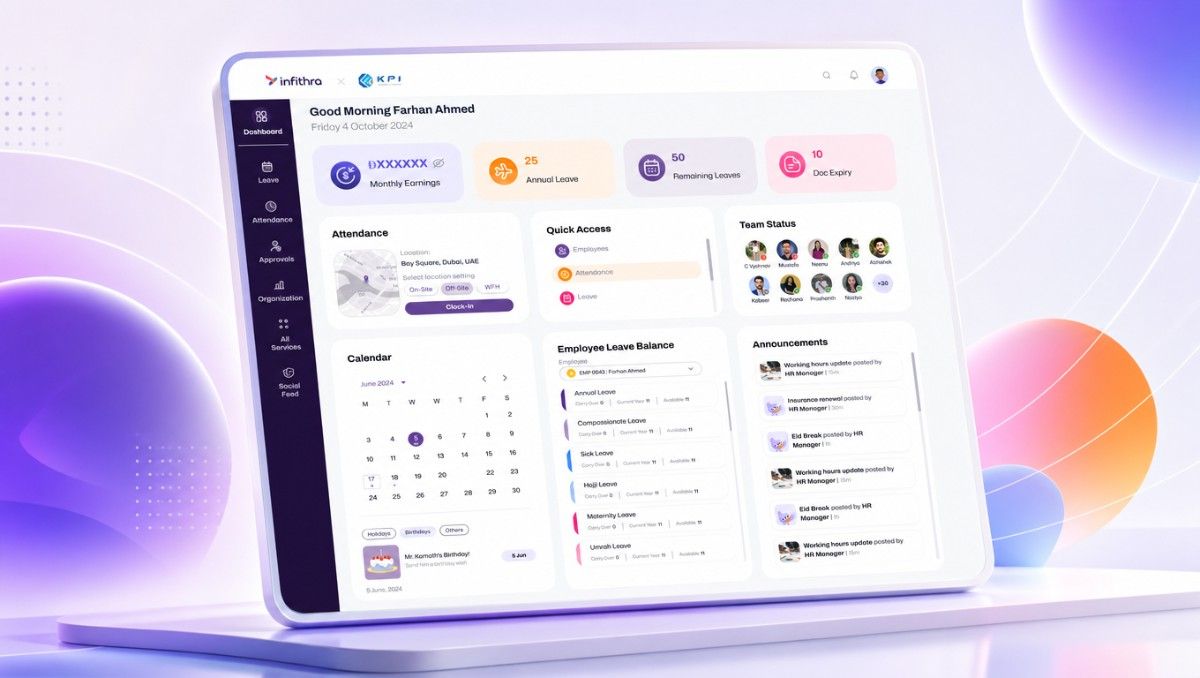
Infithra ESS Portal Dashboard Showing Employee Details for UAE Employees

Employee Self-Service, exactly as its name suggests, is a contemporary approach in human resource management. It grants employees a measure of control over administrative tasks relating to their personal information management. In simpler terms, ESS empowers employees to manage their basic tasks, such as modifying personal details, managing leave, etc., just through the app. This becomes effortless when your company’s HRMS facilitates ESS workflows!
ESS features may encompass enabling employees to:

  • Review their contact information.
  • Monitor banking details.
  • Review payslips or employee benefits.
  • Request leave or time off.
  • Lodge expense claims.
  • Check the weekly/monthly shift schedule.
  • View profiles of fellow colleagues.
  • Explore immediate team structure and reporting lines.
  • Access a comprehensive overview of their absence history and leave balance.
  • Stay informed about key business announcements.
  • Receive timely reminders to participate in polls and surveys.
  • Get alerts for expiring documents to ensure timely renewal.
  • Receive notifications for team celebrations, including birthdays, anniversaries, new starters, etc.

Understanding ESS capabilities sets the foundation; now explore key workplace challenges these platforms effectively address in modern organizations in the section below.     

Key workplace challenges addressed by ESS platforms

Every HR team has a version of the same story. Inboxes are filled with routine requests. Spreadsheets that never quite reflect reality. Employees are waiting days for updates that should take minutes. These aren’t isolated frustrations; they’re symptoms of systems that were never designed for the pace modern workplaces demand.

ESS platforms are built specifically to resolve these friction points. Here are the core workplace challenges they address:

  • Fragmented employee data management: Personal details, banking information and employment records are often scattered across multiple systems or maintained manually. This creates inconsistency and makes accurate reporting difficult to achieve at scale.
  • High volume of repetitive HR requests: HR teams regularly handle queries that employees could resolve independently, such as checking leave balances, downloading payslips or updating contact details. These low-complexity tasks consume disproportionate amounts of HR time.
  • Lack of real-time visibility for employees: Without self-service access, employees rely entirely on HR for information about their own records. This creates unnecessary dependency and delays that frustrate both sides.
  • Inefficient leave and absence coordination: Managing leave requests through email or verbal communication creates gaps in visibility. Approvals get delayed, balances go untracked and scheduling conflicts become harder to anticipate.
  • Manual attendance and timesheet errors: Recording working hours manually introduces calculation mistakes and creates disputes that require time to investigate and resolve.
  • Slow document and compliance workflows: Expired documents, missed policy acknowledgements and delayed submissions often go unnoticed until they become compliance risks.
  • Poor internal communication reach: Important announcements, policy updates and team notifications frequently fail to reach employees consistently when they rely on informal channels alone.

These challenges don’t exist in isolation. Each one compounds the others. An unresolved leave request creates scheduling uncertainty. Inaccurate attendance data affects payroll. Compliance gaps create legal exposure. Together, they place pressure on HR teams that grows heavier as the organization scales.

The good news is that addressing these challenges doesn’t require restructuring the entire HR function. It requires giving the right tools to the right people, and that’s precisely where ESS delivers.
How ESS portals benefit HR teams and employees

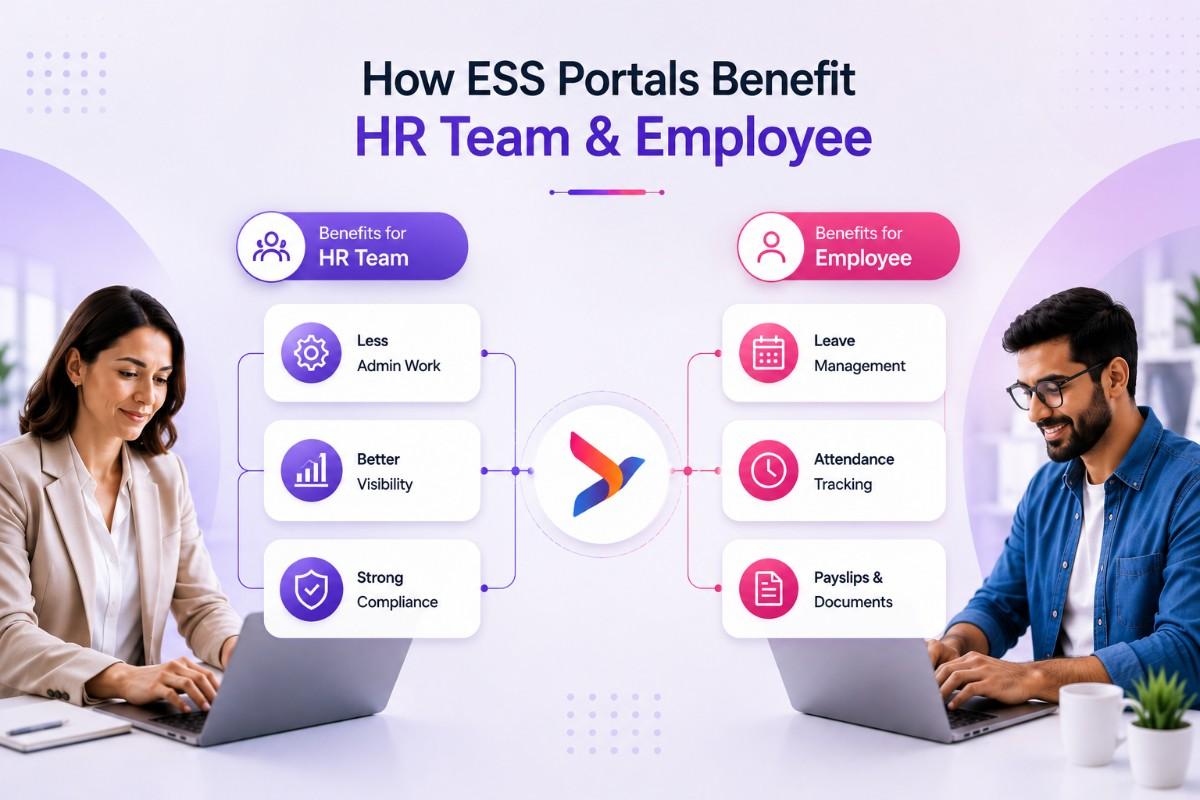
Infithra Employee Self-Service Software Benefits for UAE Businesses

Employee Self-Service portals deliver measurable value by simplifying everyday HR operations for both employees and HR teams. From automating routine tasks to improving accuracy and compliance, ESS creates a more efficient, transparent and connected workplace environment across all core HR functions.

Key benefits of ESS for HR teams and employees include:

  • Streamlining administrative tasks: Employee self service systems allow employees to handle repetitive administrative tasks, such as updating personal information, submitting documents and managing employment details, without the need for direct intervention from HR personnel.

It benefits organizational processes by streamlining the workflow by providing a centralized, user-friendly platform for employees to access and update their information independently. This will reduce the burden on HR teams and improve overall efficiency.

  • Time and attendance tracking: Managers can monitor employee working hours efficiently by implementing a system that integrates with biometric devices. This integration ensures accurate tracking of attendance data, fostering transparency in recording hours worked, overtime or absences. This streamlined process enhances communication and accountability between employers and employees. 

Implementing such a workflow streamlines manual processes, reducing the administrative burden associated with tracking working hours. It also mitigates the risk of manual calculation errors.  

  • Leave management: ESS facilitates the seamless request and approval of various types of leave. Employees can easily submit leave requests via the app, view their leave balances and track the status of their requests in real-time.

This feature enhances communication between employees and HR or line managers by streamlining the leave approval process. It ensures that HR or managers have real-time insights into employees’ current work and leave statuses.

  • Improved data accuracy and reduced errors: By allowing employees to directly input and manage their information, ESS reduces the likelihood of any data entry errors. By leveraging cloud-based HR technology, businesses can maintain accurate and up-to-date employee records with enhanced efficiency and reliability.

As businesses scale, the importance of having a unified tool for consolidating personal data becomes increasingly evident. The self-service aspect empowers employees to take ownership of their personal data, leading to improved data accuracy throughout the organization.

  • Enhanced compliance with HR policies and regulations: ESS features often come with built-in compliance checks, guiding employees to adhere to regional HR policies and regulations when submitting information or requests they are entitled to.

With a standardized and central platform fully configured to local regulations, ESS helps organizations maintain compliance with legal and internal company policies, reducing the risks of potential non-compliance and legal issues.

ESS portals enhance efficiency, accuracy and employee experience while significantly reducing HR workload and operational bottlenecks across organizations.

Selecting the right ESS solution is critical, requiring careful evaluation of functionality, scalability, integration and long-term organizational fit.

Choosing the right employee self-service portal solution

Recognizing that your organization needs an ESS portal is the straightforward part. Selecting the right one is where many businesses struggle. The market is filled with options and not all of them are built to handle the operational complexity, workforce size or regulatory environment your organization actually operates in.

The goal isn’t to find the most feature-rich platform. It’s to find the one that fits your business now and scales with it over time.

Here are the key criteria to evaluate before making that decision:

  • Functional coverage that matches your workflows: Assess whether the platform handles the specific tasks your employees and HR teams perform daily. A solution that covers leave management but lacks expense claims or document alerts creates gaps that workaround processes will fill and workarounds defeat the purpose.
  • Scalability for organizational growth: The right portal should support your current headcount and accommodate future expansion. Adding users, locations or entities shouldn’t require switching platforms or extensive reconfiguration.
  • Integration capability with existing systems: An ESS portal that operates in isolation creates data silos. Evaluate whether the solution connects with your current HRMS, payroll engine, attendance systems and other business tools, ideally through open APIs that enable clean, reliable data exchange.
  • Configurability to reflect your organization’s structure: Generic templates rarely map cleanly onto real organizational hierarchies. The platform should allow configuration of reporting lines, approval workflows, leave policies and role-based access to match how your business actually operates.
  • Data security and compliance standards: Employee data is sensitive. The solution must offer robust security features, encryption, multi-factor authentication and access controls at a minimum. It should also support compliance with the data protection regulations applicable to your operating region.
  • User experience across devices: Adoption depends on usability. A portal that works seamlessly on mobile is far more likely to see consistent employee engagement than one optimized only for desktop environments.
  • Vendor support and implementation track record: A strong product paired with a weak implementation experience leads to poor outcomes. Evaluate the vendor’s support model, onboarding process and history of successful deployments in organizations similar to yours.
  • Customization of branding and communication: The portal should feel like part of your organization, not a third-party tool bolted on. Alignment with internal branding and communication style improves employee familiarity and trust in the system from day one.

Choosing an ESS portal is ultimately a strategic decision, not just a procurement exercise. The platform you select will shape how employees interact with HR processes for years. A rushed evaluation often leads to costly migrations or low adoption rates that undermine the investment entirely.

Take the time to map your requirements clearly before comparing vendors. Involve HR, IT and a cross-section of end-users in the process. Their input surfaces practical needs that top-level feature comparisons routinely miss.

Steps to deploy employee self-service portals successfully

Successful ESS deployment requires a structured, phased approach that balances planning, integration, security and user adoption. Each step plays a critical role in ensuring smooth implementation, minimizing disruption and driving long-term efficiency across HR processes and employee interactions.

Here are the key steps to ensure a smooth and successful ESS portal implementation across your organization:

  • Assessment and planning: Clearly outline the goals and objectives of implementing the ESS portal across the organization. Understand what problems it aims to solve within the current system in place and what benefits it should bring. Analyze the requirements and preferences of the end-users with all your people. Consider factors such as accessibility, usability and easy-to-use functionality to ensure the portal meets the needs of diverse users.
  • Integration with existing systems: Ensure the ESS portal integrates seamlessly with your existing HR systems, databases and other relevant applications. A system that leverages an OpenAPI enhances interoperability, making it easier to integrate the ESS portal seamlessly with your existing HR systems and other relevant applications.

  • Data Security: Implement robust security measures to protect sensitive employee information collected by the organization. Key components for a secure ESS portal include encryption, multi-factor authentication, routine backups, built-in features for data recovery and comprehensive data protection measures.
  • Testing and deployment: Conduct thorough testing of the ESS portal with a group of representative end-users across the business. Address any issues or feedback with a focus group before moving to the deployment phase. Implement a phased rollout rather than deploying the ESS portal organization-wide at once. This approach allows for smoother transitions, easier issue identification and better support for your end-users.
  • Educate users: Run training sessions through classes, one-on-one walkthroughs, video tutorials or user manuals. Give employees the confidence to navigate the new system independently from day one.
  • Gradual transition: Phase out old processes incrementally rather than all at once. Targeted training on key features helps employees adapt without frustration or disruption to daily workflows.
  • Internal marketing: Build awareness through internal campaigns that highlight usability and value. Use polls, surveys and team chat features to position the platform as a collaborative workspace, not just an HR tool.

A structured deployment approach ensures smooth adoption, minimizes risks and maximizes the long-term value of ESS implementation across organizations.

Understanding deployment best practices naturally leads to exploring how integrated platforms like infithra elevate ESS beyond traditional HR systems.

Why choose infithra for a smarter employee self-service experience

Most HR platforms treat self-service as a module, something bolted onto an existing system to reduce inbound requests. infithra was built differently. It’s a comprehensive HRMS where the Employee self service system isn’t a layer added on top. It’s the thread running through every HR function the organization depends on.

That distinction changes what employees and HR teams actually experience day to day.

When a single action in infithra, a clock-out, a leave approval, an expense submission, automatically updates attendance records, feeds into payroll calculations and reflects in workforce reports, there’s no reconciliation step. No one manually bridges the gap between systems. The data is already where it needs to be.

Here’s what makes infithra’s approach genuinely different:

  • One system, zero silos: infithra unifies payroll, attendance, leave and ESS within a single platform architecture. Data entered once flows accurately across every HR function, eliminating the version conflicts and manual corrections that plague organizations using separate tools for each process.
  • Workflow continuity across functions: An approved leave request doesn’t just close a ticket. It simultaneously updates the employee’s balance, adjusts the team’s availability view and feeds the payroll engine, all without a single manual handoff between systems or teams.
  • Single source of truth: HR leaders, managers and employees all reference the same live data. There are no mismatches between what payroll sees and what the attendance system records. Workforce decisions are made on information everyone trusts.
  • Cross-functional reporting, built in: infithra generates workforce insights that span attendance patterns, leave utilization and headcount, without exporting data or stitching together reports from multiple platforms. The visibility exists because the data was never separated to begin with.
  • Adoption by design: infithra’s mobile-first experience means employees engage with HR processes the same way they engage with everything else, on their phones, intuitively, without needing a training session to get started. High adoption isn’t a goal to manage. It’s a natural outcome of how the platform is built.
  • Scalability without disruption: As organizations grow, adding headcount, new locations or additional entities, infithra expands with them. The underlying HR architecture doesn’t need rebuilding. New users and structures plug into the same connected system already in place.
  • Operational continuity as standard: Because payroll, attendance and leave management sit within the same platform as ESS, there’s no risk of one system falling out of sync with another during updates, integrations or organizational changes. The HR operation stays coherent as the business evolves.

The result isn’t just a more convenient employee experience, though infithra delivers that too. It’s an HR operation where accuracy is structural rather than dependent on manual coordination between disconnected tools.

For organizations that have lived with the friction of piecing together HR data from multiple platforms, infithra represents a fundamentally different starting point. ESS works well because the entire system it connects to works well and that’s a distinction most standalone self-service tools simply can’t offer.

Final thoughts

ESS is more than convenience. When employees manage their own HR interactions, they feel trusted and HR teams reclaim time for work that actually matters.

But that shift only holds when ESS connects to the broader HR infrastructure. A portal disconnected from payroll, attendance or compliance workflows simply relocates the problem.

The right ESS investment builds an environment where data flows accurately, coordination is automatic and the system grows with the organization.

If you’ve been looking for an ESS solution that does more than tick boxes, one that connects seamlessly with payroll, attendance and leave management within a single HRMS, infithra is worth a closer look.

Schedule a demo today and see firsthand how infithra transforms the employee self-service experience from a basic HR feature into a genuine operational advantage for your entire organization.

FAQs

1. What is an employee self-service system?

An employee self-service (ESS) system is a digital platform that allows employees to manage routine HR tasks independently. Employees can update personal details, request leave, access payslips, submit expenses and view attendance records without relying on HR teams for every request.

2. How does an employee self-service system work?

An employee self-service system connects employees to HR functions through a centralized portal or mobile app. Employees perform tasks directly within the platform, while the system automatically updates connected HR processes such as payroll, attendance tracking, approvals and employee records in real time.

3. What is the purpose of employee self-service portals?

The purpose of employee self-service portals is to reduce administrative workload, improve process efficiency and give employees faster access to HR services. ESS portals help organizations streamline communication, improve data accuracy and create a more connected employee experience.

4. What is the difference between ESS and HR management systems?

ESS is a digital portal that enables employees to handle HR-related tasks independently. An HR management system (HRMS) is the broader platform that manages payroll, attendance, recruitment, compliance and workforce operations. ESS typically functions as part of an HRMS.

5. What is the difference between ESS and MSS?

ESS (Employee Self-Service) is designed for employees to manage their own HR activities, such as leave requests or profile updates. MSS (Manager Self-Service) gives managers additional controls to approve requests, monitor teams, review attendance and access workforce reports.

6. Which businesses benefit most from employee self-service platforms?

Employee self-service platforms benefit businesses with growing workforces, multiple departments or distributed teams. Industries such as retail, healthcare, manufacturing, logistics and professional services often use ESS systems to improve HR efficiency, workforce visibility and employee engagement at scale.

Related Blogs