Optimize Your People and Payroll Operations with Cloud-Based HR. Try infithra Today!

Optimize Your People and Payroll Operations with Cloud-Based HR. Try infithra Today!




Automate HR operations and daily tasks
Optimize end-to-end employee lifecycles
Track working hours with smart timesheets
Streamline leave approvals on the go
Transform payroll runs through automation
Craft actionable reports on all your people
Onboard new talent through a single solution
Maximise productivity for optimal results


Accelerate early success
Efficiency for growth
Unlock scaling potential
Tailored to requirements
Role-centric solutions
Enhance operational strength
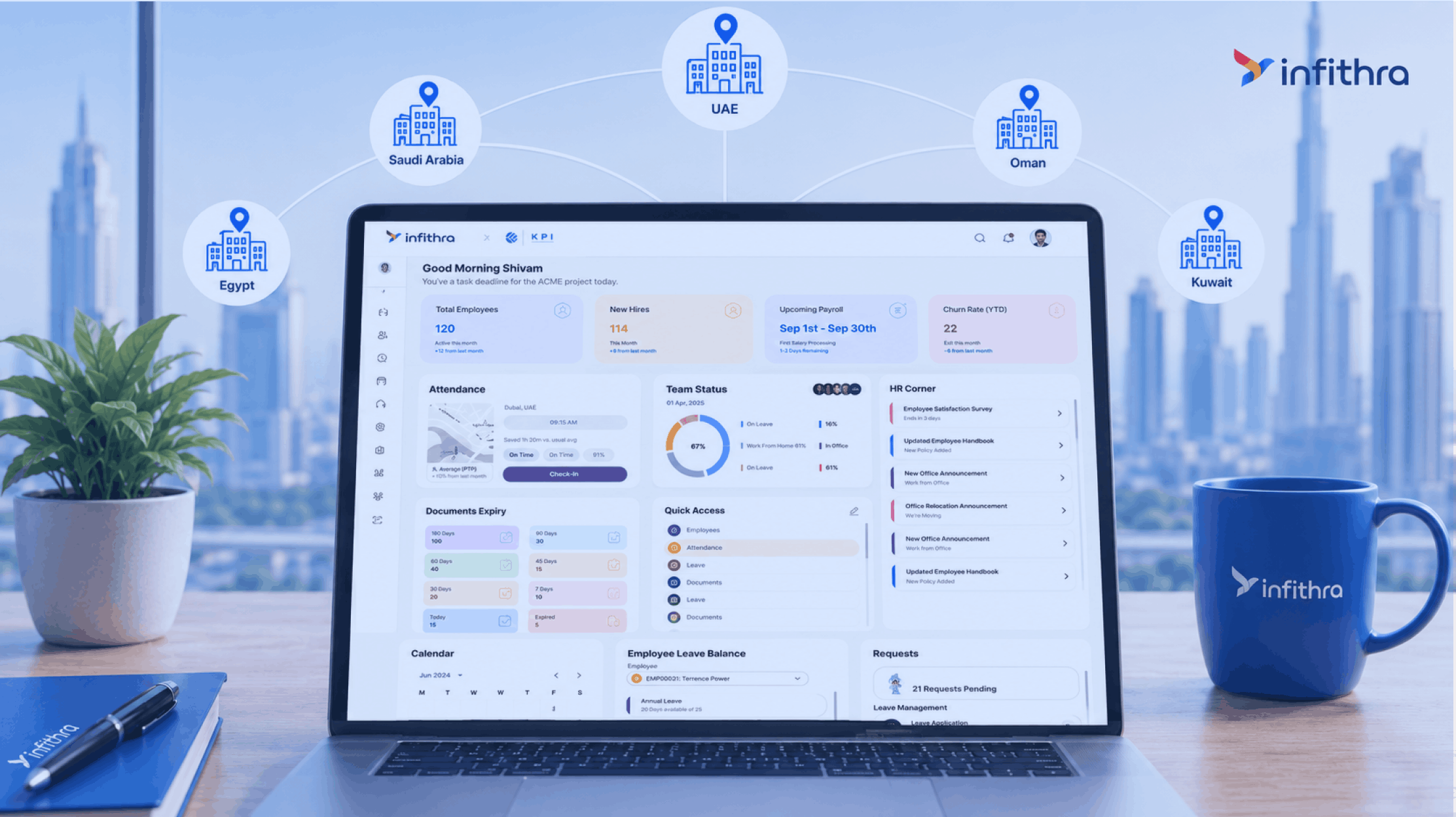
Somewhere around the 500-employee mark, most HR teams hit a wall. The spreadsheet that worked fine at 80 people starts breaking. Payroll across two office locations turns into payroll across five, each with slightly different rules. What used to be a quick conversation with a manager becomes a policy exception that needs documenting for compliance reasons.
This isn’t a sign anything went wrong. It’s just what happens when an organization scales faster than its HR infrastructure. The good news is that large enterprises across the UAE, Saudi Arabia and GCC countries have largely already solved this problem, and the patterns that work are fairly consistent once you look past the specific tools each company happens to use. This guide breaks down what actually changes as HR complexity grows, and what enterprise HR management looks like when it’s done well.
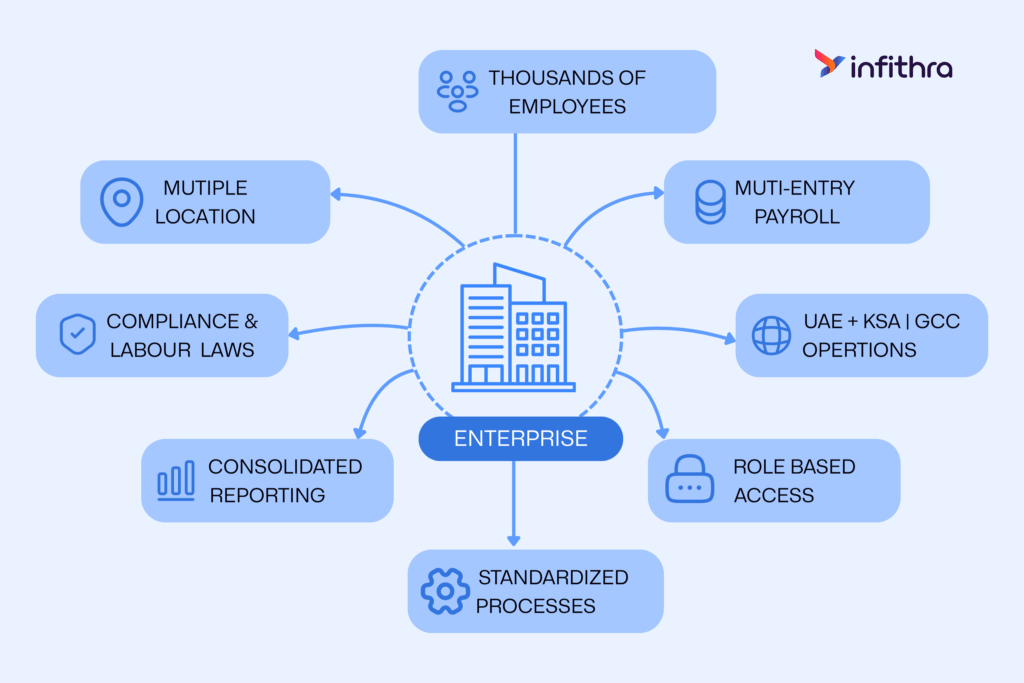
Complexity doesn’t grow at the same rate as headcount. It grows faster because the number of relationships and edge cases in an organization increases exponentially, not linearly, as more people, locations, and business units get added.
A 50-person company has one office, one set of policies, and a founder who probably still knows most people’s names. A 5,000-person enterprise might have a dozen locations across the UAE, Saudi Arabia, and GCC countries multiple business units with different reporting structures, employees on different visa and sponsorship arrangements, and a compliance obligation that changes depending on which emirate or region someone’s actually working from. Every one of those variables multiplies the number of edge cases HR has to handle correctly, every single time, without dropping anything.
An enterprise HR management system is a centralized platform designed to handle the scale, complexity, and compliance demands of a large organization, typically several hundred employees and up, spanning multiple locations, business units, or legal entities.
The difference from smaller-scale HR software isn’t really about having more features. It’s about depth. An enterprise system needs to handle multi-entity payroll correctly, support role-based permissions across a much larger management hierarchy, and generate consolidated reporting across business units without someone manually stitching together data from five different spreadsheets every month.
At scale, a single incorrect field, a wrong department code, an outdated manager assignment, can cascade into payroll errors, reporting inaccuracies, and access control problems across dozens of systems that all pull from the same underlying employee data.
Different offices often mean different local requirements, different working hour norms, different public holidays, sometimes even different languages for internal communication. Coordinating all of this consistently, without each location effectively running its own disconnected HR process, is one of the harder problems enterprise HR teams face.
Payroll gets genuinely complicated once an organization spans multiple entities. WPS compliance requirements in the UAE and Saudi Arabia, and GCC countries different SPF, Abu Dhabi Pension Fund, GOSI, and Social Insurances obligations, varying end-of-service benefit calculations, all need to run correctly and on time, every single cycle, across every entity.
Labor law, data protection law, and industry-specific regulation all apply differently depending on where an employee is based and what sector the business operates in. A single missed update, a leave policy that no longer reflects a recent labour law amendment, can create real legal exposure at enterprise scale.
The informal, everyone-knows-everyone culture that works naturally in a small company doesn’t survive scale without deliberate effort. Large enterprises have to build structured recognition programs, communication channels, and feedback loops specifically because the natural, organic version stops working once headcount crosses a certain threshold.
Without deliberate standardization, different departments or locations tend to drift toward their own versions of onboarding, approval workflows, and performance reviews. This creates inconsistency that makes reporting, compliance, and even basic fairness across the organization much harder to maintain.
Leadership at large organizations needs consolidated, accurate reporting across the entire workforce, not five disconnected reports that don’t quite reconcile with each other. Building this manually every quarter is a massive time sink and a significant source of errors when done outside a proper centralized system.
A few strategic moves consistently separate enterprises managing HR smoothly from those constantly firefighting. Centralizing data first, before adding more processes on top of a fragmented foundation, tends to fix more problems than any individual new policy could. Building standardized workflows that still allow for legitimate local variation, rather than either rigid one-size-fits-all rules or complete local autonomy, strikes the right balance most of the time. And investing in manager enablement matters enormously at scale, since managers are the ones actually executing HR policy day to day across a large, distributed organization, far more than HR itself ever directly touches most employees.
Scaling HR isn’t just about adding more HR headcount as the company grows; that approach gets expensive and doesn’t actually solve the underlying process problem. The organizations that scale well typically automate repetitive administrative work first, freeing HR capacity for higher-value work like workforce planning and manager coaching, and only then add headcount specifically for the strategic work that genuinely requires more people. A useful rule of thumb: if HR headcount is growing at the same rate as overall company headcount, something in the underlying process or technology probably needs fixing.
The tools worth investing in at enterprise scale typically go beyond a basic HRIS. Workforce planning and scheduling tools that account for multiple locations and shift patterns. Compliance monitoring systems that flag regulatory gaps automatically rather than relying on someone manually tracking every jurisdiction’s requirement. And integrated analytics that connect workforce data directly to business performance metrics, since a productivity problem at enterprise scale is genuinely hard to diagnose without data spanning multiple departments and locations at once.
Managing HR consistently across multiple locations in the UAE, Saudi Arabia, and GCC countries specifically requires a few deliberate practices. Centralized policy with documented, approved local variations, rather than each location quietly interpreting company policy its own way. A single source of truth for employee data accessible across all locations, so a transfer between offices doesn’t mean starting an employee’s HR record from scratch. Consistent WPS and payroll compliance monitoring across every entity, since a compliance gap in one location can create legal exposure across the entire organization. And regular cross-location reporting that gives leadership a genuinely unified view, rather than location-by-location snapshots that never quite add up to the full picture.
Enterprise HCM software specifically delivers value in a few concrete ways at this scale. It reduces administrative burden significantly by automating the repetitive processing that would otherwise require proportionally more HR staff as headcount grows. It improves data accuracy by removing the manual re-entry and reconciliation that introduces errors across fragmented systems. It strengthens compliance by centralizing regulatory tracking rather than relying on institutional knowledge scattered across different people and locations. And it gives leadership genuinely reliable, real-time workforce data to make faster, better-informed strategic decisions.
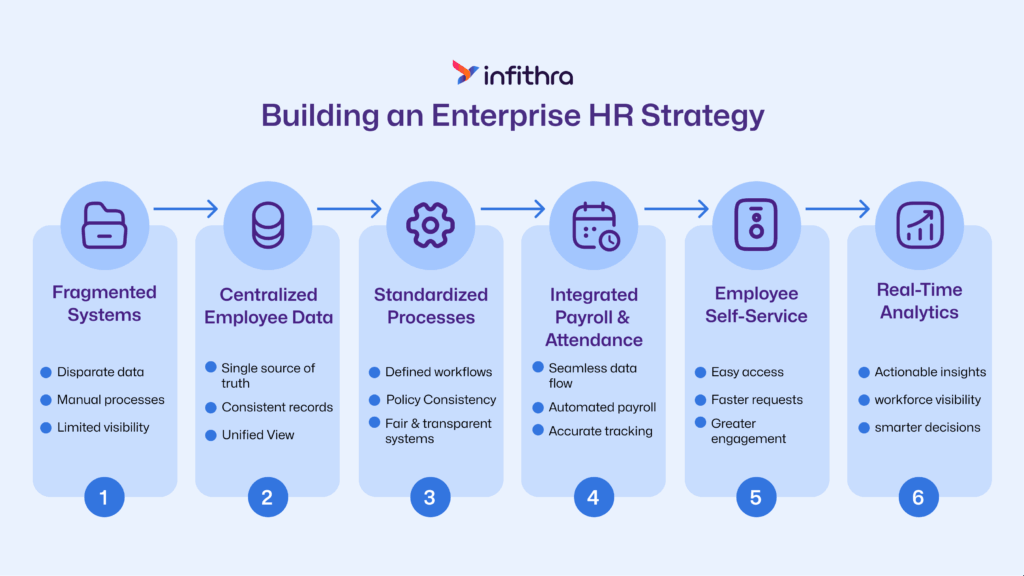
A clear framework helps here, since building this piecemeal tends to create more fragmentation, not less.
Start with what the business is actually trying to achieve- aggressive growth, geographic expansion, cost efficiency- and build the HR technology strategy around supporting that specific goal rather than adopting technology for its own sake.
Document and standardize core processes, onboarding, leave approval, and performance reviews before layering technology on top. Automating an inconsistent process just makes the inconsistency happen faster.
Choose a platform that can genuinely handle projected headcount growth and multi-entity complexity, not just current needs. Re-platforming a few years later because the initial choice couldn’t scale is expensive and disruptive.
Payroll, attendance, leave, and performance data should live in one connected system rather than requiring manual reconciliation between disconnected tools every pay cycle.
At enterprise scale, self-service isn’t a nice-to-have; it’s essential. Without it, HR simply cannot keep up with the volume of routine requests, leave balances, payslip access, and personal detail updates that a large workforce generates.
Track metrics that actually matter at scale: turnover by location and department, time to hire, compliance incident rate, rather than vanity metrics that look good in a slide deck but don’t drive decisions.
Build with headroom, choosing systems and processes that can handle double the current headcount without requiring a fundamental redesign a year or two down the line.
A few capabilities matter more at enterprise scale than they do for smaller organizations. Multi-entity and multi-location support that handles different legal entities and locations within one unified system. Role-based access control sophisticated enough to manage a large, layered management hierarchy correctly. Robust compliance tools covering statutory compliances like WPS, GOSI, and labor law requirements across the UAE and Saudi Arabia and GCC countries specifically. Consolidated, real-time reporting that doesn’t require manual data stitching. And genuine scalability, meaning the platform performs reliably whether the organization has 500 employees or 5,000, without a painful migration in between.
A few factors matter specifically for large organizations operating across this region. Multi-emirate and multi-region compliance means policies sometimes need local variation even within a single country, since specific free zones and jurisdictions can carry their own requirements. WPS integration across every entity is non-negotiable for payroll compliance in both the UAE and Saudi Arabia and GCC countries. Localization quota tracking adds another layer of workforce reporting that enterprise HR teams need to monitor continuously, not just at audit time. And with both governments actively pushing large-scale digital transformation initiatives, enterprises that keep their HR technology aligned with that broader momentum tend to face fewer compliance surprises down the line.
Cloud platforms have become the practical default at enterprise scale for a few clear reasons. They scale more gracefully than on-premises systems when headcount grows quickly across new locations. They support the kind of real-time, multi-location access that a distributed enterprise genuinely needs. And with regional cloud infrastructure now mature enough to satisfy Saudi PDPL, UAE PDPL and GCC PDPL data residency requirements directly, the old objection to cloud, that sensitive employee data would have to sit overseas, has largely been resolved for organizations that verify their vendor’s hosting location properly.
infithra is built around the operational core that enterprise HR scaling actually depends on: centralized data, reliable payroll, and genuine regional compliance support.
infithra’s Core HR gives large organizations a single source of truth for employee data across every location and business unit, removing the fragmentation that usually causes the biggest headaches at scale. Employee Management supports the layered management structures typical of larger organizations, while Payroll Management handles multi-entity, WPS-compliant payroll accurately across the UAE, Saudi Arabia and GCC Countries. Attendance Management and Leave Management keep two of the highest-volume administrative processes automated and consistent across every location, and built-in employee self-service reduces the routine request volume that would otherwise overwhelm a growing HR team. On top of all this, People Analytics gives leadership the consolidated, real-time reporting that enterprise decision-making genuinely requires, rather than reports stitched together manually every quarter.
A few shifts are already shaping how large organizations across the UAE, Saudi Arabia and GCC Countries will manage HR over the coming years. AI-assisted workforce planning is moving from experimental to mainstream, helping enterprise HR teams forecast headcount and skills needs with far more precision than manual planning ever allowed. Predictive compliance monitoring is getting more sophisticated as regulatory frameworks across the region continue to evolve, flagging gaps automatically rather than relying on periodic manual audits. Real-time, consolidated analytics is becoming the baseline expectation for enterprise leadership rather than a premium capability. And as both the UAE, Saudi Arabia and GCC Countries continue pushing national digital transformation agendas, enterprises with modern, cloud-based HR infrastructure will be considerably better positioned to adapt quickly as new requirements and opportunities emerge.
Managing HR at enterprise scale isn’t really about working harder than a smaller organization does. It’s about building the right foundation, centralized data, standardized processes, and a genuinely scalable platform, so complexity doesn’t compound faster than the HR team’s ability to manage it. The enterprises handling this well across the UAE, Saudi Arabia and GCC Countries have generally made this shift deliberately, rather than reacting to problems after they’ve already caused real damage.
If your organization is starting to feel that familiar strain as headcount grows, the fix usually isn’t more people in HR. It’s better infrastructure underneath the people already there.
Enterprise HR complexity doesn’t have to mean enterprise-level chaos. infithra gives large organizations across the UAE, Saudi Arabia and GCC Countries the centralized, compliant foundation needed to manage HR efficiently at any scale.
From Core HR and Employee Management to Payroll Management, Attendance Management, Leave Management, Performance Management and People Analytics, infithra brings every piece of enterprise HR into one connected platform, built for the compliance realities of this region from the start.
Talk to infithra today and see how a properly connected HR platform helps your organization scale without the growing pains.
An enterprise HR management system is a centralized platform built to handle the scale and complexity of large organizations, typically several hundred employees or more, spanning multiple locations or legal entities. It differs from smaller-scale HR software mainly in depth, supporting multi-entity payroll, layered access control, and consolidated reporting that smaller systems typically can’t handle well.
Most rely on centralized policy with documented, approved local variations, a single source of truth for employee data accessible across every location, and consistent compliance monitoring for requirements like WPS payroll that apply across each entity. Regular cross-location reporting also helps leadership maintain a genuinely unified view rather than disconnected location-by-location snapshots.
Enterprise HCM software reduces administrative burden through automation, improves data accuracy by eliminating manual reconciliation across fragmented systems, strengthens regulatory compliance, and gives leadership reliable, real-time workforce data for faster strategic decisions. These benefits become more significant as headcount and organizational complexity grow.
Efficient scaling usually means automating repetitive administrative work before adding more HR headcount, standardizing core processes across the organization, and choosing HR technology built to handle projected growth rather than just current needs. If HR headcount is growing at the same rate as total company headcount, it’s usually a sign that underlying process or technology needs improvement.
Multi-entity and multi-location support, sophisticated role-based access control, robust compliance tools for local requirements like WPS and labour law, consolidated real-time reporting, and genuine scalability without requiring a painful migration later are the features that matter most at enterprise scale.