Optimize Your People and Payroll Operations with Cloud-Based HR. Try infithra Today!

Optimize Your People and Payroll Operations with Cloud-Based HR. Try infithra Today!




Automate HR operations and daily tasks
Optimize end-to-end employee lifecycles
Track working hours with smart timesheets
Streamline leave approvals on the go
Transform payroll runs through automation
Craft actionable reports on all your people
Maximise productivity for optimal results
Onboard new talent through a single solution


Accelerate early success
Efficiency for growth
Unlock scaling potential
Tailored to requirements
Role-centric solutions
Enhance operational strength

Running HR across multiple locations in the GCC is less about administration and more about coordination under pressure. Payroll cycles don’t wait. Regulations don’t stay still. And even small errors can ripple across teams, finances and compliance.
Yet many businesses are still relying on systems that were never built for this level of complexity. Spreadsheets break. Manual processes lag. And compliance gaps quietly accumulate.
Cloud-based HR software is changing that. It gives GCC businesses a smarter way to manage their workforce, one that is built for scale, designed for regional compliance and accessible from anywhere.
But not all platforms are equal. Knowing what to look for, what to avoid and what actually fits the GCC context makes all the difference.
This blog breaks it all down, from what cloud HR management software really is, to the features that matter most for GCC businesses, the benefits you can expect and how to choose a solution that grows with you.
HR has moved far beyond manual processes. Today, it sits at the center of how businesses operate, plan and grow. Cloud-based HR software is the infrastructure making that shift possible.
At its core, it is a centralized platform hosted on remote servers and accessed through the internet. It connects key HR functions into one system. There is no need for heavy infrastructure or manual updates. The provider manages the backend, while your team focuses on execution.
Here is what a cloud HR platform typically includes:
The result is a system where HR data is accurate, accessible and actionable, without the manual effort that fragmented, traditional approaches demand.
Cloud-based HR software does not simply digitize existing processes. It restructures how HR operates, giving teams more control with significantly less administrative overhead.
Understanding what the software does is one part of the picture. The more immediate question for GCC businesses is why the systems they have relied on are no longer keeping up.
Also read: 5 Best Cloud HR and Payroll Software for UAE Businesses
Across the GCC, business environments are becoming more structured and demanding. Regulations are evolving quickly and workforce models are no longer simple. What once worked for smaller, localized teams is now struggling to keep up with regional scale and complexity.
Traditional HR systems were not built for this pace of change. As a result, many businesses are actively moving toward more adaptable solutions that can support both compliance and growth.
Key reasons driving this shift to modern cloud-based HR systems:
The common thread running through all of these is not a preference for newer technology. It is the practical reality that traditional systems were built for a scale and regulatory environment that GCC businesses have long since moved beyond.
The shift to cloud-based HR software is a direct response to operating demands that manual processes are no longer equipped to meet.
Knowing why businesses are making this shift is important. What matters equally is understanding which specific capabilities make a cloud HR platform genuinely fit for the GCC context.
Not every cloud HR platform is built for the GCC. Many global solutions offer broad functionality but fall short on regional compliance specifics, local government integrations and the workforce complexity that Gulf businesses manage daily.
For businesses operating across the region, the features that matter most are those designed with GCC regulatory and operational realities already accounted for, not adapted from a generic global framework.
Here are the core features GCC businesses should prioritize when evaluating a cloud HR platform:
The right platform does not simply address a compliance checklist. It becomes the operational foundation of how HR functions, accurately, consistently and in step with the regulatory environment GCC businesses operate within.
Features define what a platform is capable of. The more important question is what those capabilities actually deliver for the business day to day.
Also read: Oman Wage Protection System (WPS): How Businesses Can Stay Compliant
Knowing what a platform can do is useful. Understanding what it actually delivers for your business is what drives the decision. For GCC businesses managing complex workforces, multi-country operations and evolving compliance obligations, the benefits of cloud-based HR software go well beyond convenience. They translate directly into reduced risk, better decisions and stronger operational control.
Here are five benefits that matter most for businesses operating across the Gulf:
This reduces the administrative back-and-forth that frustrates employees and places unnecessary load on HR teams. A more responsive, transparent day-to-day experience has a demonstrable effect on engagement and, over time, on retention.
Together, these benefits shift HR from a reactive, administratively heavy function into one that actively supports business performance and compliance readiness.
For GCC businesses, the case for cloud HR management software is well established. The more practical question is how to identify the platform that fits your specific operating environment.
Not every capable platform is the right platform. For GCC businesses, the selection decision goes beyond verifying a feature list. It requires assessing whether a solution is genuinely built for your operating context or simply adaptable to it on paper.
The distinction matters. A platform that covers regional requirements in theory but lacks local implementation depth, regulatory update cycles or regional support will underperform in practice. The evaluation needs to go deeper than a product demo.
Here is how GCC businesses should approach the selection decision:
1. Assess regional compliance readiness
Key question to ask: Is the platform natively aligned with GCC regulations or does it depend on post-implementation customization?
Evaluate whether the platform is already aligned with GCC regulatory frameworks. It should demonstrate proven support for country-specific labor laws and reporting requirements, not just theoretical compatibility. If the answer relies heavily on future configuration or third-party consultants, treat that as a risk signal. This reduces dependency on manual interpretation and ensures compliance processes remain consistent as regulations evolve across jurisdictions.
2. Evaluate payroll adaptability across entities
Key question to ask: Can this system manage multi-country payroll within a single environment or will you need workarounds?
Look for evidence that the platform handles multi-country payroll without requiring parallel systems or manual adjustments. It should support varying salary structures, currencies and legal requirements within a unified setup. If payroll for each entity requires a separate process or reconciliation step, the platform is not built for GCC scale. This ensures accuracy across entities and minimizes reconciliation issues during payroll cycles.
3. Examine integration capabilities carefully
Key question to ask: Does the platform connect with your existing systems or will data silos remain?
Assess how easily the platform integrates with your ERP tools, finance software and attendance devices. It should also support government portal connections where direct integration is available or structured outputs where it is not. If integration requires significant custom development, factor that into the true cost of ownership. Strong integration reduces data silos and ensures consistent data flow across functions.
4. Prioritize usability and adoption
Key question to ask: Will your HR teams and employees actually use this system consistently?
Evaluate how intuitive the platform is for both administrators and end users. A complex system slows adoption and increases reliance on training or support. Look for clear workflows, simple navigation and mobile accessibility. If the platform requires prolonged onboarding to reach baseline usage, adoption will remain fragmented. High usability ensures consistent usage and determines how much value the system delivers over time.
5. Validate scalability and long-term fit
Key question to ask: Will this platform support your next phase of growth or will you outgrow it?
Assess whether the platform can accommodate additional entities, new GCC markets and an increasing workforce without requiring system changes. If scaling requires significant reconfiguration or a new implementation, the platform is solving for today, not tomorrow. A scalable system prevents future disruptions and ensures that expansion does not create new operational challenges.
Choosing the right platform is not about the longest feature list. It is about selecting a system that answers each of these five questions reliably, within your operational and regulatory environment.
In practice, very few platforms deliver consistently across all five. That is where the difference between a functional system and a truly dependable solution becomes clear.
Also read: Choosing the Right HR Software for Your Business in the UAE
Global HR tools were not built for the GCC. They miss WPS logic, lack government portal integrations and treat bilingual support as an afterthought. Every compliance cycle becomes a manual workaround. Every regulatory update turns into a configuration exercise.
The inefficiency compounds quietly until it becomes a liability. GCC businesses need a platform that starts where they operate, not one that arrives there through a series of patches.
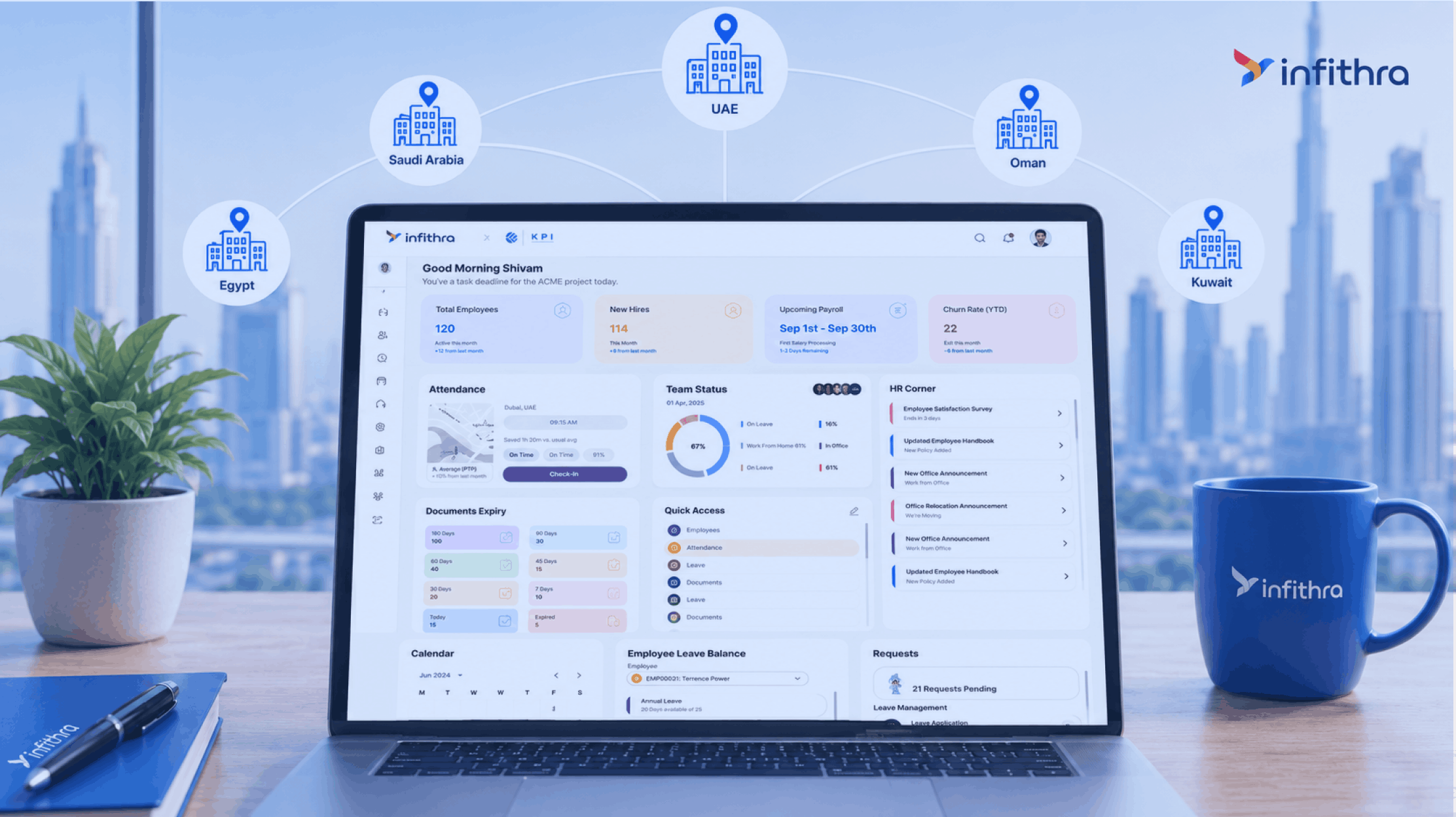
This is exactly the gap that infithra was built to address. Developed in Dubai, it is designed around the operational and regulatory realities that GCC businesses navigate every day. It is a regional platform, designed with local complexity as the starting point, not a global system retrofitted for the Gulf.
Here is what sets infithra apart for GCC businesses:
infithra brings together everything a GCC business needs to manage its workforce accurately, stay compliant across jurisdictions and operate without the friction that disconnected or under-configured systems create.
For businesses carrying the risk of manual compliance, managing multiple GCC entities on mismatched tools or simply outgrowing the systems they started with, infithra is the platform built for exactly that reality.
Cloud HR is not a simple technology upgrade. It is an operational decision that directly affects how your business runs every day.
Compliance failures carry financial penalties. Payroll errors impact employee trust. Disconnected systems slow down every process they touch. As businesses expand across the GCC, these challenges only become more difficult to manage.
The organizations handling this well are not relying on workarounds. They are using systems built for their environment. These platforms handle WPS requirements without manual fixes. They connect with GOSI and MoHRE without added layers. They scale as the business grows, without forcing reimplementation.
The GCC requires more than adaptable software. It requires systems designed with regional realities at the core.
If your current setup still relies on manual fixes or disconnected tools, it may be time to rethink it. See how a GCC-built cloud HR platform can simplify compliance, streamline payroll and support your growth. Schedule a demo to explore how infithra fits your business.

1. What is cloud-based HR software and how does it work?
Cloud-based HR software is a centralized platform hosted on remote servers and accessed through the internet. It connects core HR functions such as payroll, employee records, leave management and compliance into a single system. The provider manages updates and infrastructure. Teams can access real-time data from any location.
2. How is cloud HRMS different from traditional on-premise HR systems?
Traditional HR systems rely on local servers, manual updates and limited accessibility. Cloud HRMS software operates online and updates automatically. It removes infrastructure dependency and enables real-time access across locations. This improves data accuracy, lowers maintenance effort and supports distributed teams more effectively.
3. Why are GCC businesses shifting toward cloud-based HR solutions?
GCC businesses face increasing regulatory requirements and multi-country workforce complexity. Manual processes and legacy systems cannot keep up with this scale. Cloud HR solutions address this through structured workflows, automated compliance updates and centralized data access. This improves operational consistency and supports expansion across multiple entities.
4. Which GCC labor regulations can cloud HR software help businesses stay compliant with?
Cloud HR platforms support compliance with regulations such as Wage Protection System (WPS) requirements, GOSI contributions, Emiratization and Saudization quotas and end-of-service benefit rules. They maintain audit-ready records and adapt to regulatory changes. This supports accurate reporting and strengthens audit preparedness.
5. How does cloud HR software support WPS filing and document expiry tracking?
Cloud HR systems generate WPS-compliant payroll files aligned with UAE and Saudi requirements. These files are structured for submission through platforms such as Mudad. The system also tracks visa, passport and residency expiry dates. Automated alerts help teams stay ahead of critical deadlines.
6. Can cloud HR platforms manage multi-currency payroll across GCC countries?
Yes, cloud HR platforms are designed to handle multi-entity and multi-currency payroll. Each country’s payroll rules and statutory requirements are managed within a single system. This improves consistency across entities and minimizes reconciliation effort during payroll cycles.
7. How does cloud HR software calculate end-of-service benefits accurately?
Cloud HR platforms apply country-specific formulas for end-of-service benefits. These calculations are based on tenure, contract type and applicable labor laws. The system updates automatically when regulations change. This improves calculation accuracy and maintains compliance across jurisdictions.
8. How is sensitive employee data kept secure in a cloud HR system?
Cloud HR systems use encryption, role-based access controls and secure data storage to protect employee information. Platforms that meet international standards such as ISO 27001 and SOC 2 provide an additional layer of verified security assurance. infithra is certified to both standards, ensuring sensitive employee data across GCC and MENA operations remains protected, access-controlled and audit-ready at all times.
9. What should GCC businesses prioritize when selecting a cloud HR platform?
Businesses should evaluate regional compliance readiness, payroll adaptability across entities and integration with GCC government portals. Usability, bilingual support and scalability are equally important. The platform should align with existing operations and support future growth without re-implementation.
infithra is purpose-built for these requirements, covering WPS compliance, multi-country payroll, native Arabic and English support and seamless integration with systems including MoHRE, GOSI and leading ERP platforms, making it a strong fit for GCC businesses at any stage of growth.
10. How long does implementing cloud HR software typically take for a GCC Implementation timelines vary based on business size, data complexity and number of entities. Deployment typically ranges from a few weeks to a few months. This depends on data migration, configuration and integration requirements. Proper setup ensures smooth adoption and reliable system performance from day one.