Optimize Your People and Payroll Operations with Cloud-Based HR. Try infithra Today!

Optimize Your People and Payroll Operations with Cloud-Based HR. Try infithra Today!




Automate HR operations and daily tasks
Optimize end-to-end employee lifecycles
Track working hours with smart timesheets
Streamline leave approvals on the go
Transform payroll runs through automation
Craft actionable reports on all your people
Maximise productivity for optimal results
Onboard new talent through a single solution


Accelerate early success
Efficiency for growth
Unlock scaling potential
Tailored to requirements
Role-centric solutions
Enhance operational strength
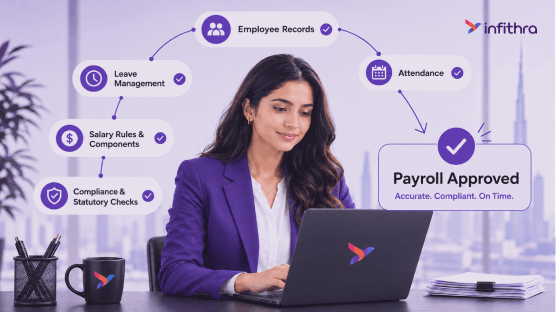
Payroll sounds simple on paper. Pay the right person the right amount on the right date. In reality, it is one of the most error-prone processes inside any organisation. A missed attendance update, an outdated salary component, or a manual entry mistake can throw off an entire payroll cycle, and in markets like the UAE, Abu Dhabi, and Saudi Arabia, and overall GCC payroll errors can also mean compliance penalties under WPS and other labour regulations.
This is why more businesses across the GCC are moving away from spreadsheets and manual processing toward automated payroll processing built into a unified HRMS. In this guide, we break down the most common payroll mistakes, how payroll automation software fixes them, and a practical payroll reconciliation workflow your HR and finance teams can start using right away.
Payroll is not just a monthly task. It is a direct reflection of how well an organisation treats its people and how seriously it takes compliance.
When payroll is accurate, employees trust the organisation, finance teams close the books faster, and HR spends less time firefighting complaints. When it is inaccurate, the fallout goes well beyond an unhappy employee. Businesses face:
For organisations operating in the UAE, Abu Dhabi, Saudi Arabia, and overall GCC where labour law compliance is closely monitored, payroll accuracy is not optional. It is a business-critical function that needs the right systems behind it, not just good intentions.
Before fixing the problem, it helps to know exactly where things go wrong. Here are the common payroll mistakes that show up most often in growing businesses:
Most of these issues share one root cause: payroll is still being managed as a standalone, manual process instead of being connected to the rest of the HR ecosystem.
Automated payroll processing means using software to calculate, validate, and disburse employee salaries without relying on manual spreadsheets or disconnected systems. Instead of an HR or finance executive pulling attendance, leave, and salary data from different files every month, an HRMS platform pulls this data automatically, applies the correct payroll rules, and generates a validated payroll run with a clear audit trail.
At its core, automated payroll processing covers:
This is different from simply using accounting software to process payments. Payroll automation software is built specifically to understand labour law rules, salary structures, and workforce data, which is exactly why it reduces errors far more effectively than generic spreadsheets or basic accounting tools.
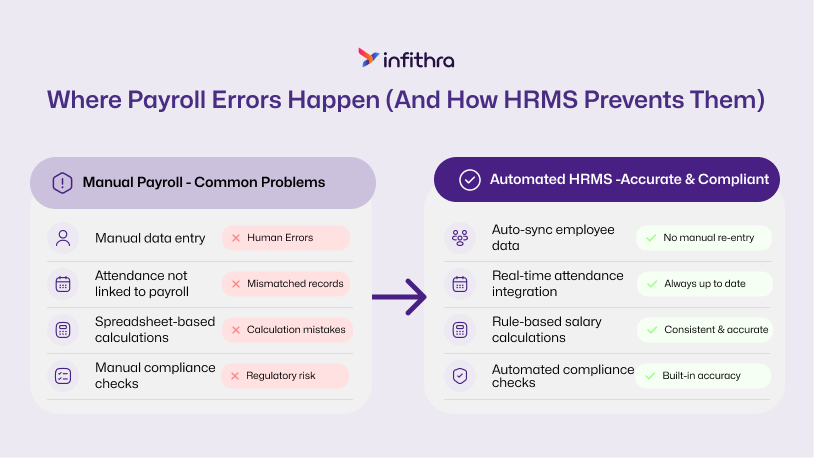
A well-designed HRMS does not just speed up payroll. It closes the specific gaps that cause errors in the first place. Here is how it works in practice.
When attendance, leave, and salary data flow directly into the payroll engine, there is no need to retype numbers from one spreadsheet to another. This single change removes one of the biggest sources of human error in payroll.
Instead of every payroll officer applying rules slightly differently, the system applies the same salary structure, allowance logic, and deduction rules consistently across every employee and every pay cycle.
Basic pay, overtime, allowances, deductions, and statutory contributions are calculated automatically based on pre-configured rules, removing the guesswork and manual formulas that often break during month-end pressure.
Payroll pulls live attendance and leave records instead of relying on someone manually reconciling timesheets. This alone prevents a large share of the errors HR teams deal with every month.
Centralised employee data means there is one single source of truth. Resigned employees, transferred staff, or duplicate profiles are flagged and cleaned up automatically instead of quietly sitting in the payroll file.
Before a payroll run is finalised, the system checks for anomalies, such as a salary that is unusually high or low compared to the previous cycle, missing bank details, or incomplete employee records.
Payroll summaries, WPS files, cost center reports, and compliance documentation are generated automatically, which reduces the risk of manual reporting errors during audits or management reviews.
Payroll does not exist in isolation. It depends on accurate attendance, leave, employee, and compensation data. This is why HRMS payroll integration is one of the most important factors in reducing payroll errors.
When payroll is built as a connected module inside a broader HRMS rather than a standalone tool, organisations get:
Businesses that run payroll separately from HR often end up doing the integration manually, through spreadsheets and email chains. That manual bridge is exactly where most payroll errors creep in.
Automated salary calculation is where the real accuracy gains happen. Once salary structures, allowance rules, and deduction policies are configured correctly inside the system, every payroll cycle applies them the same way, every time.
This matters especially for organisations with:
With automated salary calculation, a change in an employee’s basic pay or allowance automatically reflects in the next payroll run, with no need for manual recalculation. This removes the guesswork and significantly lowers the chance of a wrong payment going out.
Compliance is one of the biggest reasons businesses in the UAE, Saudi Arabia and overall GCC are moving to payroll compliance software. Labour regulations in the region are specific, and getting them wrong carries real financial and legal consequences.
Payroll compliance software helps by:
Instead of relying on someone manually tracking every regulatory update, the system is configured to apply these rules automatically, which significantly reduces the risk of fines, rejected salary files, or non-compliance flags during audits.
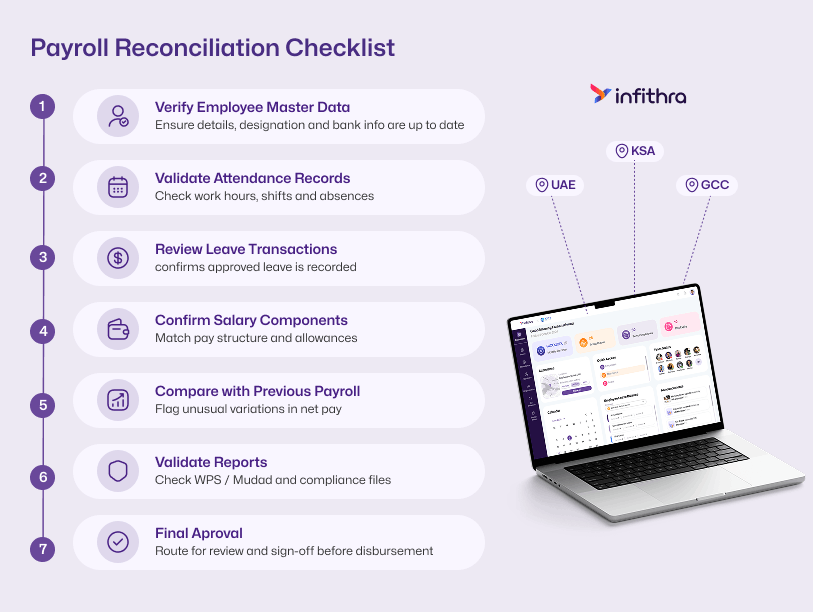
A strong payroll reconciliation process is what stands between a clean payroll run and a costly correction cycle later. Here is a practical, step-by-step workflow HR and finance teams can follow before finalising any payroll cycle.
Start by confirming that employee details, designation, department, salary structure, and bank information are current. Any recent joiners, exits, transfers, or promotions should already be reflected.
Cross-check attendance data against approved schedules and shift patterns. Look for missing punches, unapproved absences, or attendance records that were never regularised.
Confirm that approved leave, whether paid, unpaid, or sick leave, has been correctly recorded and reflected in the payroll cycle before calculations are run.
Check that basic pay, allowances, incentives, and deductions match the employee’s current contract and any approved revisions. This step catches outdated salary structures before they cause an incorrect payment.
Compare the current payroll run against the previous cycle. Significant unexplained variations in net pay for any employee should be flagged and investigated before approval.
Review the generated payroll summary, cost center allocation, and statutory contribution reports for consistency. This is also the stage to confirm WPS or Mudad file formatting is correct.
Once every step above is verified, route the payroll run through a formal approval workflow before disbursement. A documented approval trail protects the business during audits and internal reviews.
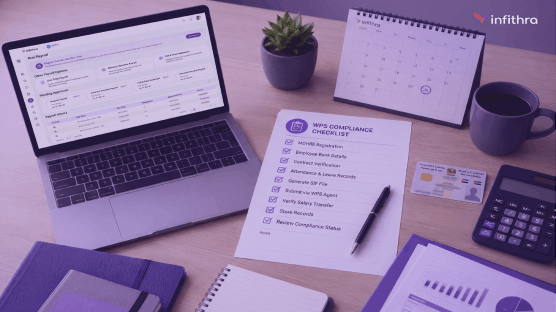
A simple payroll audit checklist helps HR and finance teams catch issues before they turn into bigger problems. Use this as a recurring monthly or quarterly check:
Running through this checklist consistently turns payroll accuracy from a one-time fix into an ongoing habit.
Beyond software, a few operational habits go a long way in keeping payroll clean:
None of these practices require heavy manual effort once the right HRMS is in place. They simply need to be built into the monthly routine.
Payroll in the UAE, Saudi Arabia and GCC comes with region-specific requirements that businesses cannot afford to overlook.
In the UAE, this includes staying compliant with the Wage Protection System, correctly calculating end-of-service gratuity, and keeping accurate records for MOHRE-related audits. Salary transfers must match WPS file formatting exactly, or they risk being rejected.
In Saudi Arabia, businesses need to align payroll with Mudad and GOSI contribution requirements, manage Saudization-related reporting where applicable, and ensure salary certificates and payslips meet local documentation standards.
For organisations operating across both the UAE and Abu Dhabi, and expanding into Saudi Arabia and anywhere in GCC, the smartest approach is a single HRMS that can handle multiple entities, currencies, and compliance frameworks from one platform, instead of running separate manual processes for each location.
infithra helps organisations simplify payroll by connecting HR, attendance, leave, and payroll processes within a unified cloud HRMS. This reduces manual work, improves payroll accuracy, and supports compliance across the UAE, Abu Dhabi, Saudi Arabia and overall GCC.
Rather than treating payroll as a separate system that needs constant manual reconciliation, infithra’s Payroll Management module works alongside Core HR, Attendance Management, and Leave Management to make sure the numbers feeding into every payroll run are already accurate before calculations even begin.
As payroll technology continues to evolve, infithra is investing in advanced analytics and future AI-powered capabilities to further enhance payroll efficiency. Stay tuned for upcoming innovations designed to make payroll even more predictive and self-correcting.
Payroll automation is moving well beyond simple calculation engines. A few trends are shaping where things are headed next:
Organisations that adopt these capabilities early will spend far less time correcting payroll and far more time using payroll data to make better workforce decisions.
Payroll errors are rarely caused by one big mistake. They build up from small gaps: a spreadsheet that was not updated, attendance data that never made it into the payroll file, or a salary structure that changed without anyone updating the system. The fix is not more manual double-checking. It is connecting HR, attendance, leave, and payroll into one automated system that applies the same accurate rules every single cycle.
For businesses in the UAE, Abu Dhabi, and Saudi Arabia, where compliance requirements are strict and payroll mistakes carry real financial risk, automated HRMS software is quickly becoming the standard rather than the exception.
Manual payroll processes will always carry risk, no matter how careful your team is. The real fix is a system that gets attendance, leave, and salary data right before payroll is even calculated.
With infithra’s unified HRMS, you get accurate, compliant, and automated payroll built on top of connected Core HR, Employee Management, Attendance Management, and Leave Management data, along with People Analytics to help you spot workforce trends before they become payroll problems.
Talk to the infithra team today and see how much simpler payroll can be when your entire HR ecosystem works together.
The most common payroll errors include manual data entry mistakes, mismatched attendance and leave records, outdated salary structures, incorrect overtime calculations, missed statutory deductions, and duplicate employee records. Most of these happen when payroll is managed manually or on disconnected spreadsheets.
Automated payroll processing pulls attendance, leave, and salary data directly into the payroll engine, applies consistent calculation rules, and validates the data before disbursement. This removes manual re-entry, standardises calculations, and flags anomalies before they turn into payment errors.
HRMS payroll integration connects payroll with core HR, attendance, and leave data on one platform. This means payroll always works with real-time, accurate information instead of manually reconciled files, which significantly reduces the chances of errors and delays.
A solid payroll audit checklist should cover employee master data accuracy, attendance and leave reconciliation, salary structure verification, statutory contribution checks, WPS or Mudad file validation, duplicate record checks, and a documented payroll approval trail.
Businesses can improve compliance by using payroll compliance software that automatically applies WPS requirements in the UAE and Mudad and GOSI requirements in Saudi Arabia, maintains accurate records for audits, and keeps a clear approval and change history for every payroll cycle.