Optimize Your People and Payroll Operations with Cloud-Based HR. Try infithra Today!

Optimize Your People and Payroll Operations with Cloud-Based HR. Try infithra Today!




Automate HR operations and daily tasks
Optimize end-to-end employee lifecycles
Track working hours with smart timesheets
Streamline leave approvals on the go
Transform payroll runs through automation
Craft actionable reports on all your people
Maximise productivity for optimal results
Onboard new talent through a single solution


Accelerate early success
Efficiency for growth
Unlock scaling potential
Tailored to requirements
Role-centric solutions
Enhance operational strength
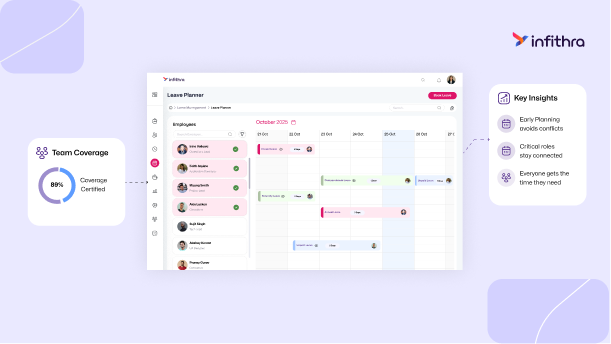
Every June, the same thing happens. Inboxes fill up with leave requests, half the team wants the same two weeks off, and someone in HR ends up playing referee between five different vacation plans. If that sounds familiar, you’re not alone. Summer is, without question, the toughest stretch of the year for anyone managing people.
But here’s the thing: it doesn’t have to be chaos. With a bit of structure, the right policy, and a system that actually shows you who’s off and when, HR and people ops teams across the UAE, Abu Dhabi, and Saudi Arabia and GCC can get through summer without scrambling. This guide breaks down where things usually go wrong, what actually works, and how the right tools take a lot of the guesswork out of it.
Ask any HR manager which season causes the most leave-related headaches, and summer wins almost every time. School holidays line up, families want to travel together, and suddenly half the office wants the same three weeks. Handle it badly and you end up with thin coverage, missed deadlines, and a team that feels like approvals are basically random.
There’s more riding on this than most people realize. Good planning keeps the business running when key people step away. It also shapes how employees experience the whole process; nobody wants to feel like their vacation depends on who emailed HR first. And frankly, it affects how much people trust HR in general. A department that handles PTO fairly earns a lot of goodwill that carries into everything else.
Teams that plan for summer tend to see something else too: happier employees. When people know the process is consistent, rather than a free-for-all, they stop stressing about whether their request will even get a fair look.
Most of the pain points HR teams run into every summer aren’t new. They repeat, year after year, usually because nobody addressed them the first time around.
Someone always has to hear “no” when three or four people want the identical week off. And if there’s no real logic behind who gets approved first, that “no” starts to feel personal, even when it isn’t.
Smaller teams feel this the most. Lose even one or two people during a busy week, and suddenly there aren’t enough hands to keep things moving.
Payroll can’t just pause for a week. Neither can customer support or IT. Approving leave without checking who else covers that role first is how gaps happen.
A surprising number of companies still leave through spreadsheets or paper forms. It works, until it doesn’t. Double bookings, stale balances, and approvals that quietly fall through the cracks are all symptoms of the same problem.
A family emergency doesn’t wait for approval deadlines. Sudden requests are inevitable, but handling them without undermining employees who planned months requires a clear, consistent approach.
People compare notes. If marketing approves overlapping leave freely while operations enforces a hard cap, word gets around, and it doesn’t sit well with anyone.
Once you know where the friction usually shows up, the fix is less about reacting and more about building something proactive before summer even starts.
Put it in writing. How overlapping requests get resolved, what documentation is needed, when exceptions apply- all of it. A written policy gives everyone the same reference point instead of relying on memory or whoever happens to be around.
The earlier people submit requests, the more room managers have to actually plan around them, rather than scrambling two days before someone leaves.
A cutoff for standard summer requests keeps the process from turning into a last-minute pile-up and gives managers breathing room to check coverage properly.
Not every seat carries equal weight during peak season. Knowing which ones absolutely need coverage helps managers make smarter calls when requests clash.
A shared calendar that everyone can see does something a spreadsheet buried in someone’s inbox never will: it makes conflicts obvious immediately, before they turn into approval disputes.
Decide, in advance, how many people need to be present per department per day. It gives managers a clear, defensible reason to stagger requests instead of just guessing.
Teams that can cover for each other handle absences far better. It’s an investment that pays off well beyond summer, too, since it reduces reliance on any single person.
For the busiest stretches, temporary staff or short-term contractors can fill gaps without burning out the employees who stayed.
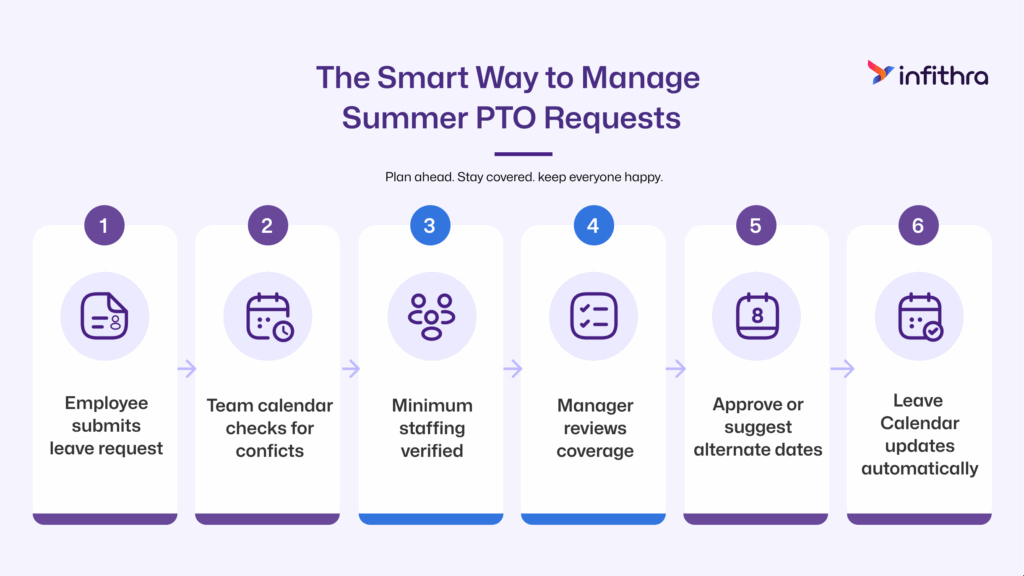
Handling day-to-day requests is one thing. Stepping back and building a real strategy around leave is another, and it’s where a lot of HR teams still fall short.
Manual approval chains are slow and error-prone, plain and simple. Automated workflows send requests to the right person immediately and leave a clean record behind, no guessing who approved what.
When people know exactly how decisions get made, whether it’s seniority, submission date, or role criticality, complaints about favouritism tend to disappear.
Nobody wants to approve leave someone doesn’t actually have, or deny a request they’ve clearly earned. Real-time balances fix both problems at once.
Instead of managing approvals person by person, cap the number of concurrent leaves per department. It’s a simple rule that scales cleanly no matter how big the organization gets.
Which weeks got hit hardest last summer? That data tells you where to expect pressure this year, before it catches anyone off guard.
Even a rejected request lands better when there’s an actual explanation attached. Silence, or a vague “not approved,” breeds resentment fast.
A live picture of who’s in, who’s out, and who’s partially available means managers can react the moment something unexpected happens, instead of finding out too late.
Managers are really the first line of defence here. Push your team to plan early, rotate priority for the most popular weeks so the same people don’t always win, and check in periodically rather than waiting for a formal request to land. It also helps to sit down and look at the team calendar together at the start of summer. That one conversation often prevents half the conflicts that would otherwise show up in July.
At some point, spreadsheets stop cutting it. Once a team grows past a certain size, especially across offices in the UAE, Abu Dhabi, or Saudi Arabia or GCC, manual tracking just can’t keep pace with the volume. This is where dedicated leave management software earns its keep.
Employees submit requests from wherever they are, no more chasing emails or hunting down a paper form.
Requests route to the right approver automatically, cutting response times down considerably.
Balances stay accurate and current, so there’s no more mental math or arguments over how many days someone actually has left.
Everyone works from the same view of who’s away, which means overlapping requests get caught early instead of after the fact.
When leave data talks to attendance records directly, payroll and staffing calculations stay accurate without anyone reconciling numbers by hand.
People can request leave, check balances, or track approval status right from their phone, genuinely useful for field staff or anyone not sitting at a desk all day.
The system checks each request against company policy automatically, flagging anything that breaks the rules before it lands on a manager’s desk.
Automatic reminders keep approvals from sitting untouched for days during the busiest weeks of the year.
A single dashboard shows coverage across every department at a glance, so staffing gaps get noticed while there’s still time to fix them.
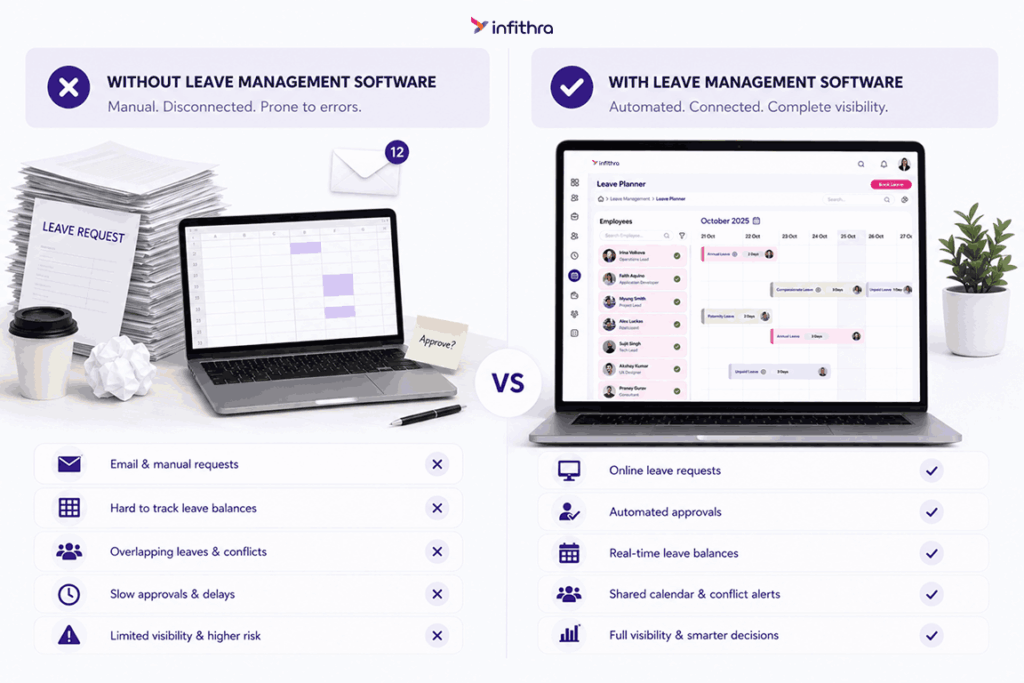
Preventing understaffing really comes down to seeing problems coming instead of reacting to them. Set staffing thresholds before requests start rolling in. Stagger approvals across teams rather than approving strictly by who asked first. Keep communication open so nobody’s surprised by a decision. And check coverage weekly through the busiest months, not just at the moment of approval, so small issues get caught before they turn into real ones.
The biggest one? Approving purely first-come, first-served without looking at the wider team impact. Close behind that: not communicating the policy clearly before summer even starts, ignoring what happened last year, and relying on outdated spreadsheets that nobody bothered to update. Skipping cross-department visibility causes plenty of trouble too, since a manager might approve leave without knowing another team is already stretched thin that same week.
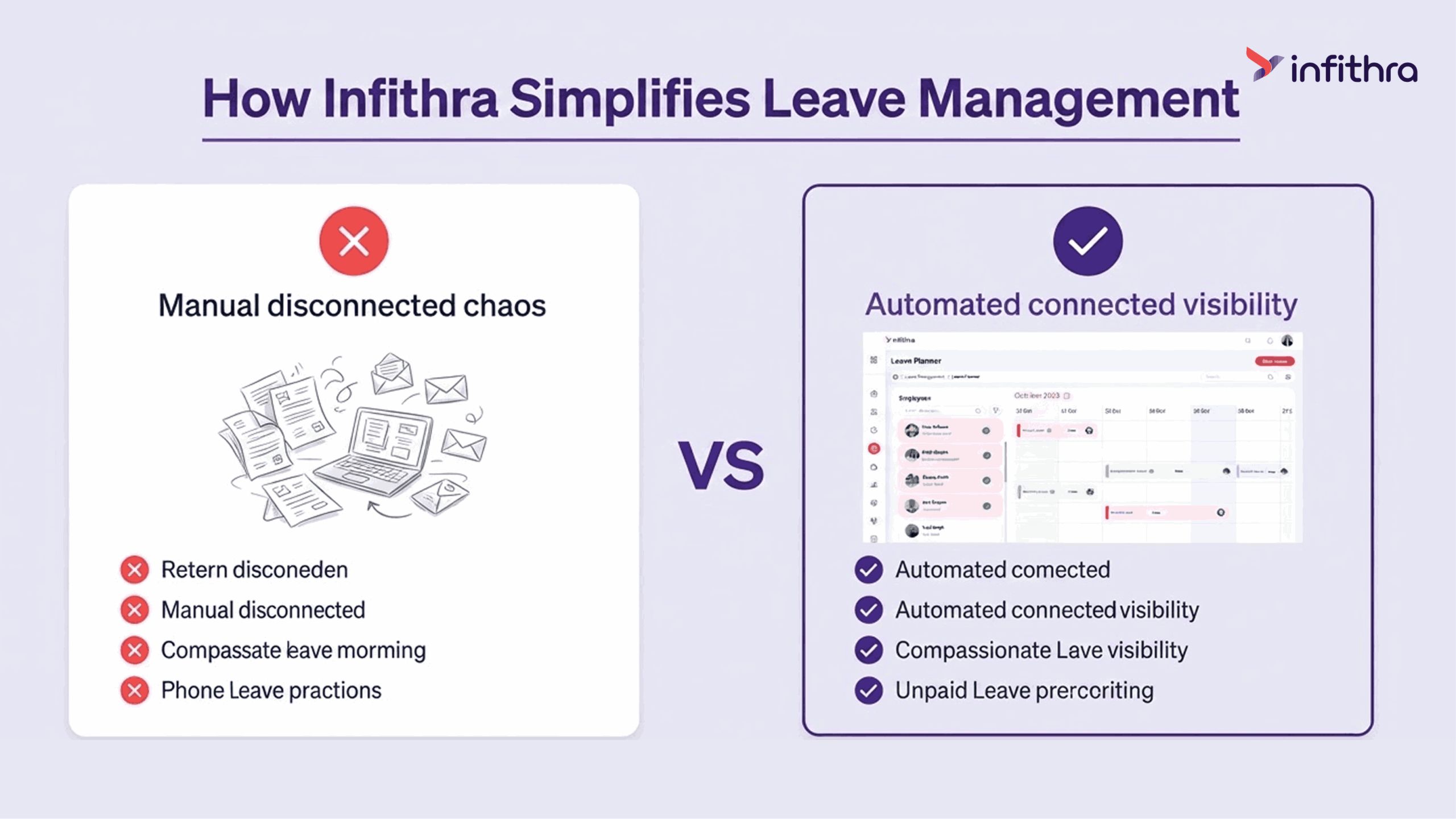
This is exactly the kind of problem infithra was built to solve. Instead of piecing together spreadsheets, email threads, and separate systems that don’t talk to each other, HR teams get
one connected HRMS platform covering leave requests, approvals, balances, and staffing visibility, all in real time.
With infithra’s leave management software, employees submit and track requests digitally, managers approve with full visibility into team coverage, and HR isn’t stuck reconciling numbers manually. Because it connects directly with the attendance management system, businesses always know, in real time, who’s actually at work and who isn’t.
Leave Planner Configuration: Add Leave Planner configuration screens to define rules such as allowing a maximum of 2 employees from the same department to be on leave on a particular day. Once the limit is reached, the system automatically restricts the 3rd employee from applying for leave on that date. This will help ensure consistent, transparent and unbiased leave management.
Leave Planner: Mobile & Platform: Add Leave Planner screens on both Mobile and Platform, allowing employees and administrators to view leave availability, overlapping. Based on the configured rules, the system intelligently shows availability and restrict leave requests when the defined limit is reached.
Summer PTO is just one piece of a much bigger puzzle. infithra offers a full suite of tools built for HR and payroll teams across the UAE, Abu Dhabi, Saudi Arabia and GCC:
Want to stop dreading summer scheduling? Reach out to infithra and see how a connected HRMS keeps your team staffed, your employees genuinely happy, and your summer running the way it should.
Summer PTO doesn’t have to mean thin coverage or approval decisions that feel unfair. A clear policy, early planning, some cross-training, and the right software give HR teams the visibility they need to say yes with confidence. The companies that get through summer smoothly are, almost always, the ones that planned instead of reacting in the moment.
Set minimum staffing levels per department, use a shared leave calendar to catch overlaps early, and apply consistent rules, like request date or role criticality, so decisions don’t feel arbitrary.
Automating requests, tracking balances in real time, capping concurrent leave per department, and reviewing what happened in previous summers all rank among the most effective strategies.
It gives HR real-time visibility into who’s on leave, connects directly with attendance data, and flags policy conflicts automatically, so coverage gaps get caught before they cause problems.
Check current team coverage, confirm critical roles stay staffed, review the employee’s actual leave balance, and make sure the decision lines up with company-wide policy.
Start with a written policy, apply the same approval criteria across every team, and always explain the reasoning behind a decision, backed by a system that records requests accurately.